3:31 p.m.
So I think at least one aspect of this is solvable. You can modify the
request metric data directly in a custom policy. You can access and modify
the request metric like this:
{code}
protected void doApply(ApiResponse response, IPolicyContext context, C
config, IPolicyChain<ApiResponse> chain) {
RequestMetric metric = context.getAttribute("apiman.request-metric",
null);
metric.setFailure(true);
metric.setFailureCode(12345);
metric.setFailureReason("Backend API failed for a reason!"";
chain.doApply(response);
}
{code}
That will allow you to make sure the metrics information is correct for
your use-case. The policy context (and thus the request metric object) is
also available to data policies:
https://github.com/apiman/apiman/blob/master/gateway/engine/core/src/main...
Does that make sense? Is there more to your use-case?
-Eric
On Fri, Feb 3, 2017 at 6:48 AM, Marc Savy <marc.savy(a)redhat.com> wrote:
Aha, you're specifically talking about the apiman UI - I had
thought from
the context that you were using an external tool like Grafana.
I'll let Eric respond as he implemented that code.
On 3 February 2017 at 11:38, Balu S <sbalu27(a)gmail.com> wrote:
> sorry, I don't understand what you wrote.
>
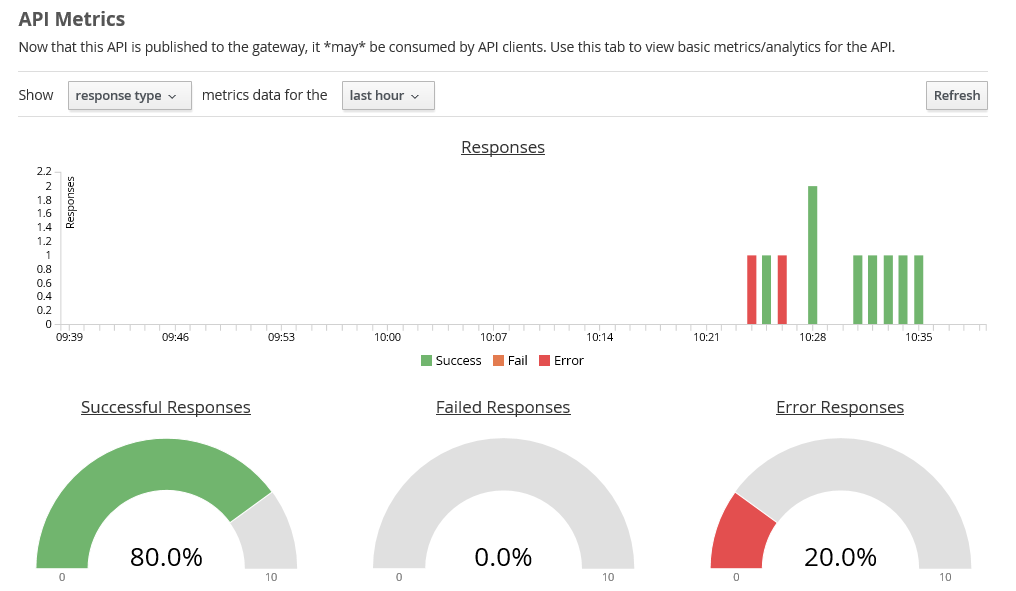
> I would like Apiman metrics to consider the HTTP response (>=400) as
> failure/error (whatever that is appropriate) and indicate in below charts.
>
>
>
> [image: Inline image 1]
>
> On Fri, Feb 3, 2017 at 12:21 PM, Marc Savy <marc.savy(a)redhat.com> wrote:
>
>> I think I understand what you're asking.
>>
>> IIRC:
>>
>> Error = an exception occurred within the gateway (e.g. could not connect
>> to backend).
>> Failure = a policy failure occurred.
>>
>>
>> If you're wanting to look at http exception codes, just look at the
>> 'responseCode' field in the ES Metrics.
>>
>> If you're wanting a "failed/not failed" determination then perhaps
just
>> execute `responseCode/100 == 2` in your analysis? Or is this not possible
>> in your use-case?
>>
>> On 3 February 2017 at 10:45, Balu S <sbalu27(a)gmail.com> wrote:
>>
>>> Its the default one ES.
>>>
>>> # ---------------------------------------------------------------------
>>> # Elasticsearch Metrics Settings
>>> # ---------------------------------------------------------------------
>>>
>>> apiman-gateway.metrics=io.apiman.gateway.engine.es.ESMetrics
>>> apiman-gateway.metrics.client.type=jest
>>> apiman-gateway.metrics.client.protocol=${apiman.es.protocol}
>>> apiman-gateway.metrics.client.host=${apiman.es.host}
>>> apiman-gateway.metrics.client.port=${apiman.es.port}
>>> apiman-gateway.metrics.client.username=${apiman.es.username}
>>> apiman-gateway.metrics.client.password=${apiman.es.password}
>>> apiman-gateway.metrics.client.timeout=${apiman.es.timeout}
>>> apiman-gateway.metrics.client.initialize=true
>>>
>>> On Fri, Feb 3, 2017 at 11:40 AM, Marc Savy <marc.savy(a)redhat.com>
>>> wrote:
>>>
>>>> Which metrics implementation are you using? The data you're talking
>>>> about should be in there; if it's not then there's a problem.
>>>>
>>>>
>>>> On 3 February 2017 at 09:50, Balu S <sbalu27(a)gmail.com> wrote:
>>>>
>>>>> Thanks for your inputs.
>>>>>
>>>>> Yes, I mean HTTP error codes (non-200) that are returned to client.
>>>>> For example, when a request is missing query parameters and the API
>>>>> responds with a "Bad request" (400) along with error XML.
Here the error
>>>>> code is set at HTTP level only and Apiman metrics should consider it
as bad
>>>>> response (in my opinion). Neither I do not see the Apiman source
>>>>> (HttpApiConnection) interpreting the HTTP response using the HTTP
code. But
>>>>> with the custom policy, If I check for non-200 code and handle as
failure,
>>>>> then metrics shows them as error.
>>>>>
>>>>> To clarify on my implementation with custom policy, I'm not
trying to
>>>>> change the HTTP error code based on the response, rather we are
unpacking
>>>>> the error response body and packing in different XML format as done
by
>>>>> Apiman. Is this not a valid scenario ? I think there could other
scenarios
>>>>> where one want to alter the response body. I agree there will be
additional
>>>>> cost to performance and memory, but can it be not done one demand
basis
>>>>> like how one can implement IDataPolicy to parse the response only if
he
>>>>> needs to.
>>>>>
>>>>> Thanks
>>>>> Balu
>>>>>
>>>>>
>>>>>
>>>>>
>>>>>
>>>>> On Thu, Feb 2, 2017 at 10:31 PM, Eric Wittmann <
>>>>> eric.wittmann(a)redhat.com> wrote:
>>>>>
>>>>>> The bottom line here is that you cannot return a Policy Failure
(or
>>>>>> customize it) based on information in the response body. The
response is
>>>>>> streamed from the back-end to the client, and at the time
streaming begins,
>>>>>> the response code and HTTP headers have already been sent.
>>>>>>
>>>>>> It sounds to me like you're asking for a feature where you
can parse
>>>>>> the response body *before* the policy's "apply"
method is invoked. We have
>>>>>> such a feature for requests, but not for responses. I suspect
core changes
>>>>>> to apiman would be required to enable that. It seems like a
reasonable
>>>>>> request to me, as long as users of the feature understand the
performance
>>>>>> and memory requirements of enabling it.
>>>>>>
>>>>>> -Eric
>>>>>>
>>>>>>
>>>>>> On Thu, Feb 2, 2017 at 1:03 PM, Marc Savy
<marc.savy(a)redhat.com>
>>>>>> wrote:
>>>>>>
>>>>>>> NB: This is distinct from the body you're setting which
contains a
>>>>>>> JSON/XML payload containing the error code. It's in the
HTTP protocol
>>>>>>> itself.
>>>>>>>
>>>>>>> On 2 February 2017 at 18:02, Marc Savy
<marc.savy(a)redhat.com>
>>>>>>> wrote:
>>>>>>>
>>>>>>>> That sounds like metrics are going wrong, or perhaps
you're
>>>>>>>> misinterpreting it (adding Eric).
>>>>>>>>
>>>>>>>> When you say your API returns an error, does it still
return an
>>>>>>>> appropriate non-200 error code at the HTTP level? For
instance, 500 or
>>>>>>>> similar? That's very important.
>>>>>>>>
>>>>>>>> There's a difference between an error and a failure -
have you
>>>>>>>> checked both of those fields to see whether they contain
the information
>>>>>>>> you're expecting to see.
>>>>>>>>
>>>>>>>> Certainly in my experience we *do* collect the metrics
you're
>>>>>>>> talking about, unless I'm misunderstanding you.
>>>>>>>>
>>>>>>>> On 2 February 2017 at 17:40, Balu S
<sbalu27(a)gmail.com> wrote:
>>>>>>>>
>>>>>>>>> Hi Marc,
>>>>>>>>>
>>>>>>>>> I shall explain my use case. From our API call, we
return error
>>>>>>>>> response (in XML or JSON) for 401, 500 and so on.
However, Apiman metrics
>>>>>>>>> seems to just consider them as good response (it is,
as Apiman received the
>>>>>>>>> response back) and show as successful response. So I
have made custom
>>>>>>>>> policy to intercept the response to know if it is
failure and trigger the
>>>>>>>>> Policy Failure. This is fairly simple and straight
forward as the response
>>>>>>>>> code will just do the purpose. But I want also to add
some additional
>>>>>>>>> information about the failure to Policy Failure. This
additional
>>>>>>>>> information is in the original error response which
will be lost once
>>>>>>>>> doFailure() happens. And no we don't want to
those additional information
>>>>>>>>> in some HTTP headers to pass around. Hence I
implemented responseHandler()
>>>>>>>>> to handle the response buffer and like you pointed
out, it seems to be too
>>>>>>>>> late to meddle the response.
>>>>>>>>>
>>>>>>>>> So ideally, there are possible 2 solution
>>>>>>>>>
>>>>>>>>> - Apiman metrics can interpret the response as
unsuccessful
>>>>>>>>> for such error response from API call.
>>>>>>>>> - Handle the response buffer data before the
write() call to
>>>>>>>>> response outputstream.
>>>>>>>>>
>>>>>>>>> Do you see any alternative solution?
>>>>>>>>>
>>>>>>>>> Thanks
>>>>>>>>> Balu
>>>>>>>>>
>>>>>>>>> On Thu, Feb 2, 2017 at 6:15 PM, Marc Savy
<marc.savy(a)redhat.com>
>>>>>>>>> wrote:
>>>>>>>>>
>>>>>>>>>> Hi,
>>>>>>>>>>
>>>>>>>>>> Perhaps URLRewritingPolicy
https://github.com/apiman/apim
>>>>>>>>>>
an/blob/master/gateway/engine/policies/src/main/java/io/apim
>>>>>>>>>>
an/gateway/engine/policies/URLRewritingPolicy.java be an
>>>>>>>>>> informative place to start?
>>>>>>>>>>
>>>>>>>>>> - Apiman streams data, so the client may be
receiving data
>>>>>>>>>> already by the time you've determined you
want to cancel (the connection is
>>>>>>>>>> already established; headers have been sent) -
it's often too late to
>>>>>>>>>> gracefully cancel. You could try throwing an
exception and seeing what
>>>>>>>>>> happens (not recommended practice!).
>>>>>>>>>>
>>>>>>>>>> If that doesn't work, perhaps you can explain
your use-case more
>>>>>>>>>> clearly and explicitly so we can see what the
alternatives are?
>>>>>>>>>>
>>>>>>>>>> - Policies are *static* instances, if you are
assigning that
>>>>>>>>>> buffer to the object then it's as if you were
writing "static Buffer
>>>>>>>>>> buffer" and different requests will all
share that variable (and thus swap
>>>>>>>>>> it out repeatedly!).
>>>>>>>>>>
>>>>>>>>>> Regards,
>>>>>>>>>> Marc
>>>>>>>>>>
>>>>>>>>>>
>>>>>>>>>>
>>>>>>>>>>
>>>>>>>>>>
>>>>>>>>>> On 2 February 2017 at 16:56, Balu S
<sbalu27(a)gmail.com> wrote:
>>>>>>>>>>
>>>>>>>>>>> Hello,
>>>>>>>>>>> I'm trying to parse the response using
responseDataHandler() in
>>>>>>>>>>> the custom policy. In cases, if the response
from API is of certain
>>>>>>>>>>> content, I would like the Apiman to consider
as failure. But I don't find a
>>>>>>>>>>> way to throw policy failure from
responseDataHandler(). And I cannot
>>>>>>>>>>> achieve this in doApply() as the ApiResponse
object does not have "content"
>>>>>>>>>>> to parse.
>>>>>>>>>>>
>>>>>>>>>>> Also, what I found is write(chunk) in the
AbstractStream is
>>>>>>>>>>> called after doApply, so I cannot set any
attributes in it to fetch it in
>>>>>>>>>>> doApply() and trigger doFailure().
>>>>>>>>>>>
>>>>>>>>>>> For example, in below call, how to throw as
policy failure
>>>>>>>>>>> after parsing the contents ? Or how can I
access response content even
>>>>>>>>>>> before write() method.
>>>>>>>>>>>
>>>>>>>>>>>
>>>>>>>>>>> *URLRewritingPolicy.java*
>>>>>>>>>>>
>>>>>>>>>>> @Override
>>>>>>>>>>> protected
IReadWriteStream<ApiResponse>
>>>>>>>>>>> responseDataHandler(ApiResponse response,
>>>>>>>>>>> IPolicyContext context,
URLRewritingConfig
>>>>>>>>>>> policyConfiguration) {
>>>>>>>>>>> if
(policyConfiguration.isProcessResponseBody()) {
>>>>>>>>>>> return new
URLRewritingStream(context.get
>>>>>>>>>>> Component(IBufferFactoryComponent.class),
response,
>>>>>>>>>>>
policyConfiguration.getFromRegex(),
>>>>>>>>>>> policyConfiguration.getToReplacement());
>>>>>>>>>>> } else {
>>>>>>>>>>> return null;
>>>>>>>>>>> }
>>>>>>>>>>> }
>>>>>>>>>>>
>>>>>>>>>>> *URLRewritingStream.java*
>>>>>>>>>>>
>>>>>>>>>>> /**
>>>>>>>>>>> * @see io.apiman.gateway.engine.io.Ab
>>>>>>>>>>>
stractStream#write(io.apiman.gateway.engine.io.IApimanBuffer)
>>>>>>>>>>> */
>>>>>>>>>>> @Override
>>>>>>>>>>> public void write(IApimanBuffer chunk) {
>>>>>>>>>>> if (buffer == null) {
>>>>>>>>>>> buffer =
bufferFactory.cloneBuffer(chunk);
>>>>>>>>>>> } else {
>>>>>>>>>>> buffer.append(chunk);
>>>>>>>>>>> }
>>>>>>>>>>> atEnd = false;
>>>>>>>>>>> processBuffer();
>>>>>>>>>>> }
>>>>>>>>>>>
>>>>>>>>>>>
>>>>>>>>>>> Best regards
>>>>>>>>>>> Balu
>>>>>>>>>>>
>>>>>>>>>>>
_______________________________________________
>>>>>>>>>>> Apiman-user mailing list
>>>>>>>>>>> Apiman-user(a)lists.jboss.org
>>>>>>>>>>>
https://lists.jboss.org/mailman/listinfo/apiman-user
>>>>>>>>>>>
>>>>>>>>>>>
>>>>>>>>>>
>>>>>>>>>
>>>>>>>>
>>>>>>>
>>>>>>
>>>>>
>>>>
>>>
>>
>