
9:34 a.m.
User development,
The document "JBossClusteringPatternFarCache", was updated Feb 22, 2010
by Manik Surtani.
To view the document, visit:
http://community.jboss.org/docs/DOC-10292#cf
Document:
--------------------------------------------------------------
h2. Session affinity, large cluster, no replication, use of a far cache
h3. IMPORTANT NOTE:
This page discusses the far cache concept in terms of "sessions". The
configuration below is not a supported configuration for http session replication in the
JBoss Application Server, and will not necessarily work properly if implemented. Readers
of this page should think of the concepts on this page in terms of how to manage cached
data that is logically "owned" by one server in a cluster, but which needs to be
available to other servers in case of a failover. An HttpSession is conceptually that kind
of data, but meeting the servlet spec and the full set of expected behaviors of an
HttpSession mean that a sophisticated integration layer is required on top of the JBoss
Cache. The current integration layer in JBoss AS will not work reliably with the
configuration below.
h3. Author
Manik Surtani (mailto:manik@jboss.org)
h3. Use case
You have a large cluster of application servers and the overhead of replicating state is
high. Network traffic and memory usage on each node is a problem and scaling is
difficult.
h3. Prerequisites
To use this pattern, you must:
* Use a load balancer
* Use sticky sessions
* JBoss Cache 1.3.0 "Wasabi" and above
h3. Description
JBoss Cache 1.3.0 has several features that can be used to help this scenario,
specifically TCP or RMI based delegating cache loaders.
Since sessions are sticky, there is often no need for each node in the cluster to have
access to all session data. As such, it is safe to switch off replication altogether -
set CacheMode to LOCAL. Immediate savings in replication traffic and memory overhead.
But what happens if a node drops out and another node needs to take over the session
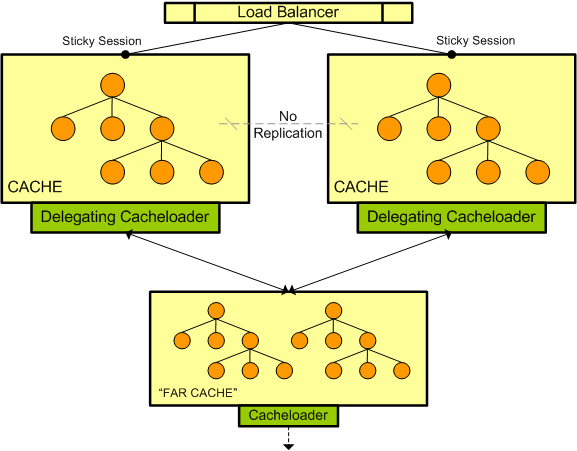
data? This is where the far cache comes in. Each cache is configured with a TCP (or RMI)
delegating cache loader, called a +far cache+. This cache loader points to a dedicated
host somewhere which acts as a large in-memory far cache. Using (potentially
asynchronous) cache loader semantics, each cache writes back to the far cache as a single
backup store of data.
http://community.jboss.org/servlet/JiveServlet/download/10292-10-4701/Far...
As shown above, the far cache is implemented as a single, standalone instance of JBoss
Cache with a TCP or RMI listener. This can even be deployed as an MBean in JBoss Cache
1.3.0 (see JBoss Cache documentation for this). The far cache can even be optionally
backed by a JDBC cache loader to persist it's in-memory state.
h3. Sample configuration
h4. Configuring JBoss Cache on your cluster
<?xml version="1.0" encoding="UTF-8"?>
<server>
<classpath codebase="./lib" archives="jboss-cache.jar,
jgroups.jar"></classpath>
<mbean code="org.jboss.cache.TreeCache"
name="jboss.cache:service=TreeCache">
<depends>jboss:service=Naming</depends>
<depends>jboss:service=TransactionManager</depends>
<attribute
name="TransactionManagerLookupClass">org.jboss.cache.DummyTransactionManagerLookup</attribute>
<attribute
name="IsolationLevel">REPEATABLE_READ</attribute>
<attribute name="CacheMode">LOCAL</attribute>
<attribute name="UseReplQueue">false</attribute>
<attribute name="LockAcquisitionTimeout">10000</attribute>
<attribute name="UseMarshalling">false</attribute>
<attribute name="CacheLoaderConfiguration">
<config>
<shared>true</shared>
<cacheloader>
<class>org.jboss.cache.loader.tcp.TcpDelegatingCacheLoader</class>
<properties>
host=far-cache.mydomain.com
port=7500
</properties>
<async>true</async>
<fetchPersistentState>false</fetchPersistentState>
<ignoreModifications>false</ignoreModifications>
</cacheloader>
</config>
</attribute>
</mbean>
</server>
h4. Deploying a TCP based far cache as an MBean in JBoss AS on a standalone 'far
cache' node
<?xml version="1.0" encoding="UTF-8"?>
<server>
<classpath codebase="./lib"
archives="jboss-cache.jar"></classpath>
<mbean code="org.jboss.cache.loader.tcp.TcpCacheServer"
name="jboss.cache:service=TcpCacheServer">
<depends optional-attribute-name="Cache"
proxy-type="attribute">jboss.cache:service=TreeCache</depends>
<attribute
name="BindAddress">${jboss.bind.address:localhost}</attribute>
<attribute name="Port">7500</attribute>
<attribute name="MBeanServerName"></attribute>
<!--<attribute
name="CacheName">jboss.cache:service=TreeCache</attribute>-->
</mbean>
</server>
*Referenced by:*
--------------------------------------------------------------
5965
days inactive
5965
days old
0 comments
1 participants
participants (1)
-
 Manik Surtani