9:33 a.m.
User development,
The document "JBossCacheMVCC", was updated Feb 22, 2010
by Manik Surtani.
To view the document, visit:
http://community.jboss.org/docs/DOC-10272#cf
Document:
--------------------------------------------------------------
Design of replacing both pessimistic and optimistic locking in JBoss Cache with a Java
memory based implementation of
http://en.wikipedia.org/wiki/Multiversion_concurrency_control.
* JIRA - http://jira.jboss.com/jira/browse/JBCACHE-1151
* http://www.jboss.com/index.html?module=bb&op=viewtopic&p=4064626#...
h2. Background
This is about changing the current locking strategies with JBoss Cache. We currently
support optimistic and pessimistic locking, but both these schemes have certain problems:
h3. Pessimistic locking
* Poor concurrency - writers block readers
* Increased potential for deadlocks (TimeoutException)
* Issues when readers upgrade to writers (http://jira.jboss.com/jira/browse/JBCACHE-97)
h3. Optimistic locking
* High memory overhead and low scalability since each reader and writer transaction copies
data to a workspace.
* Expensive post-transaction comparison phase
* Can only implement 1 isolation mode
h3. Overall
* Too many configuration/tuning options makes things confusing
* Lots of unnecessary code complexity
h2. What is MVCC?
Multi-Version Concurrency Control is a generic term for versioning data to allow for
non-blocking reads. RDMBSs often implement some
form of MVCC to achieve high concurrency. Our proposed implementation of MVCC takes
advantage of Java memory semantics.
h3. About JBossCache MVCC
* Readers all read the node directly
* When writing, the node is copied and writes made to the copy.
** Exclusive lock obtained on copy.
** Only 1 writable copy is maintained per node
*** Readers aren't blocked during writes
*** Only 1 writer allowed
* (R-R only) When writing (before tx commits, even), the writer compares versions with the
underlying node
** Either throws an exception (default) or overwrites the node anyway (accept-write-skew
option)
h4. Repeatable-Read Example
1. Cache starts at N(1)
2. Tx1 reads: has a ref to N(1)
3. Tx2 reads: has a ref to N(1)
4. Tx2 writes: has a ref to N(1)'
5. Tx2 commits: cache is N(2)
6. Tx1 reads: still sees N(1)
h3. Benefits over optimistic locking
* Low memory footprint - only 1 copy per write!
* Allows for all isolation modes
* More flexible handling of version mismatches (overwrites can optionally be allowed)
* Fail-fast when version checking is enabled (failure occurs on write, not commit)
* Able to provide forceWriteLock (SELECT FOR UPDATE) semantics, which O/L does not do
h3. Benefits over pessimistic locking
* No upgrade exceptions
* Better concurrency
* Non-blocking reads
* No dirty read race in READ_COMMITTED
h3. Other benefits
* Much simpler code base to maintain, debug
** Single set of interceptors
** Locks much simpler, no upgrades
** Standard Java references and garbage collection to take care of thread/tx isolation
(see implementation design below)
* Simpler configuration
** Isolation level : READ_UNCOMMITTED, READ_COMMITTED (default), REPEATABLE_READ,
SERIALIZABLE
** Write-skew handling : Reject (default), Accept
** Locking scheme : striped (default), one-to-one
h3. Supported isolation levels
We're considering only supporting READ_COMMITTED, REPEATABLE_READ and SERIALIZABLE.
We feel that lower isolation levels are pretty much academic and don't really have
much real world use. We're also considering using READ_COMMITTED as a default - this
is what most database implementation use to achieve high concurrency.
If lower isolation levels are specified, should we allow this, but substitute for a higher
isolation level?
h2. Implementation Design
h3. Errata
The following points have been added to the design after review of the diagrams that
follow. Note that some concepts represented in the diagrams may conflict with the errata
that follow; the errata will take precedence.
1. Versioning, along with a write skew check, is not necessary in READ_COMMITTED since
doing a write at any time means the exclusive writer would be expected to update the last
committed version. As such, READ_COMMITTED would delegate to an UnversionedNode instead
of a VersionedNode, and the write skew check would be skipped.
2. Locks should be acquired directly by querying a LockManager implementation (either
StripedLockManager or PerNodeLockManager, or maybe even in future DistributedLockManager)
rather than making lock() and unlock() calls on the node directly. While doing this on a
node is cleaner in an "OO" purist view, it does bring up problems seen with the
current pessimistic locking approach where, for example, attempting a delete on a node
that does not exist entails creating the node just so the lock can be obtained and then
deleting it again.
3. RepeatableReadNode doesn't need to hold a reference to the original node
(repeatable read sequence diagram, step 26) since this can be peeked afresh.
4. For the sake of transactions, all "updated" node copies made (when attempting
a write) should have their references placed in the TransactionEntry. Future reads in the
same transaction (such as repeatable read sequence diagram step 6) should first consult
the TransactionEntry in case a reference to the copy should be used before doing a peek.
h3. Overview
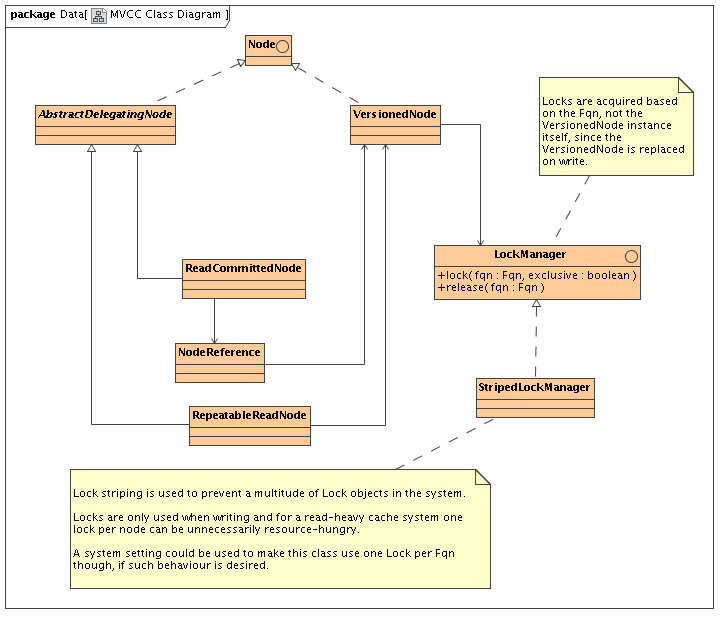
h4. Basic class diagram of relevant bits
http://community.jboss.org/servlet/JiveServlet/download/10272-50-4675/Cla...
h4. Description
* When a user gets a hold of a Node using Cache.getRoot().getChild() we will return a new
instance of ReadCommittedNode or RepeatableReadNode every time.
** AbstractDelegatingNode subclasses are very lightweight objects that just hold a
reference, and cheap to construct
*** RepeatableReadNode holds a reference to VersionedNode in the cache and delegates calls
to it
*** ReadCommittedNode holds a reference to a NodeReference, which holds a *volatile*
reference to a VersionedNode and delegates calls to it
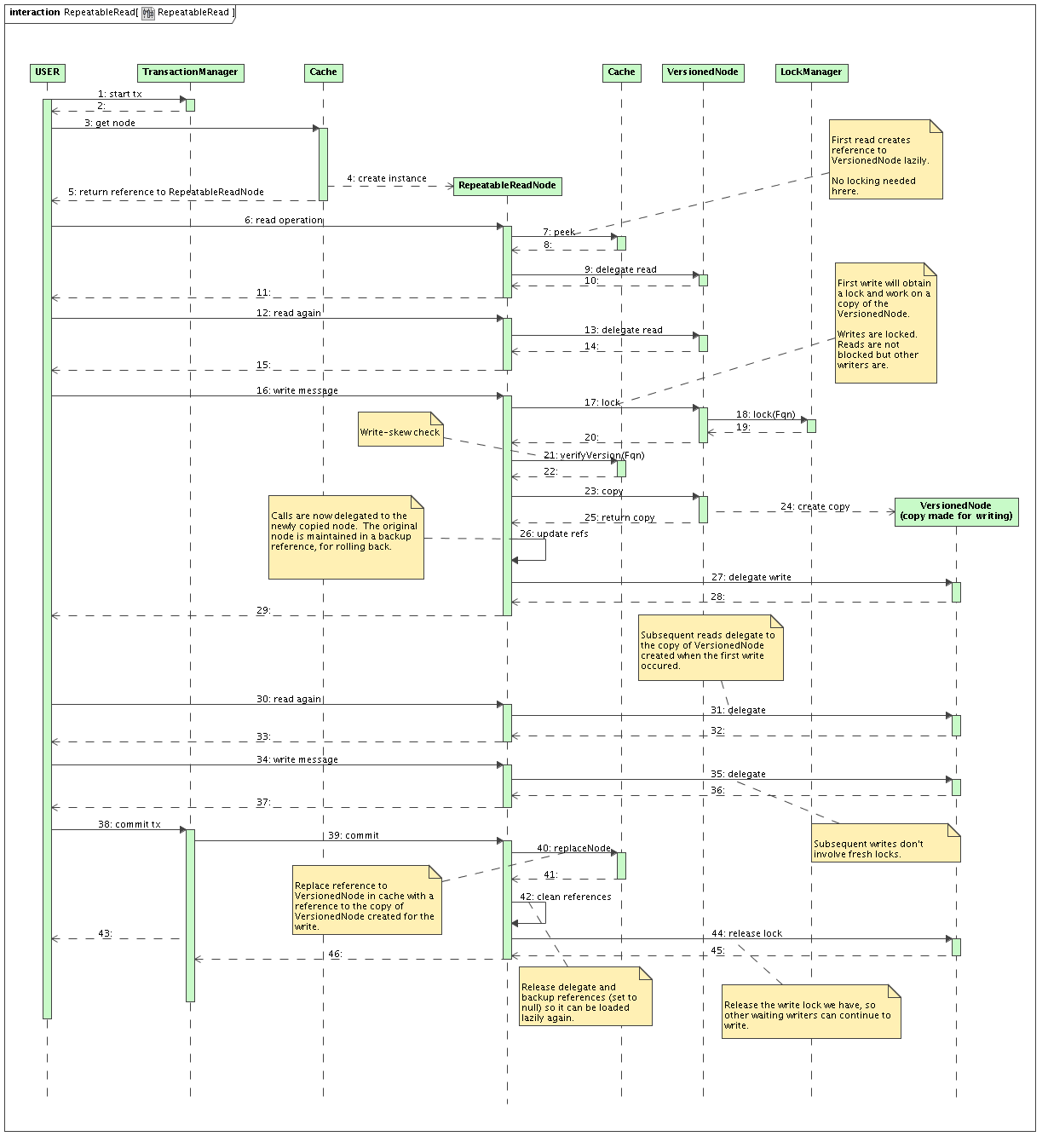
h3. REPEATABLE_READ
http://community.jboss.org/servlet/JiveServlet/download/10272-50-4678/Rep...
* Readers all end up delegating calls to the VersionedNode.
** Reference to VersionedNode created lazily on first invocation.
* When writing,
** Acquire exclusive Fqn lock (see section on locking below)
** The version of the reference held in RepeatableReadNode is checked against version in
the cache (to detect write skew)
** copies the VersionedNode
*** since exclusive lock is held, only one write-copy per node will ever exist
** increments it's version
** backs up it's original VersionedNode reference
** and updates it's delegate reference to the newly copied VersionedNode
* When committing
** Replaces the original VersionedNode in the cache with the write copy
** Discards backup pointer
** Discards VersionedNode reference so this is fetched lazily when the next transaction
starts, in case the RepeatableReadNode instance is reused.
h4. Repeatable read is achieved since:
* Readers all still point to their version of VersionedNode (reference still held by other
RepeatableReadNode instances)
* Writer works with it's copy of VersionedNode
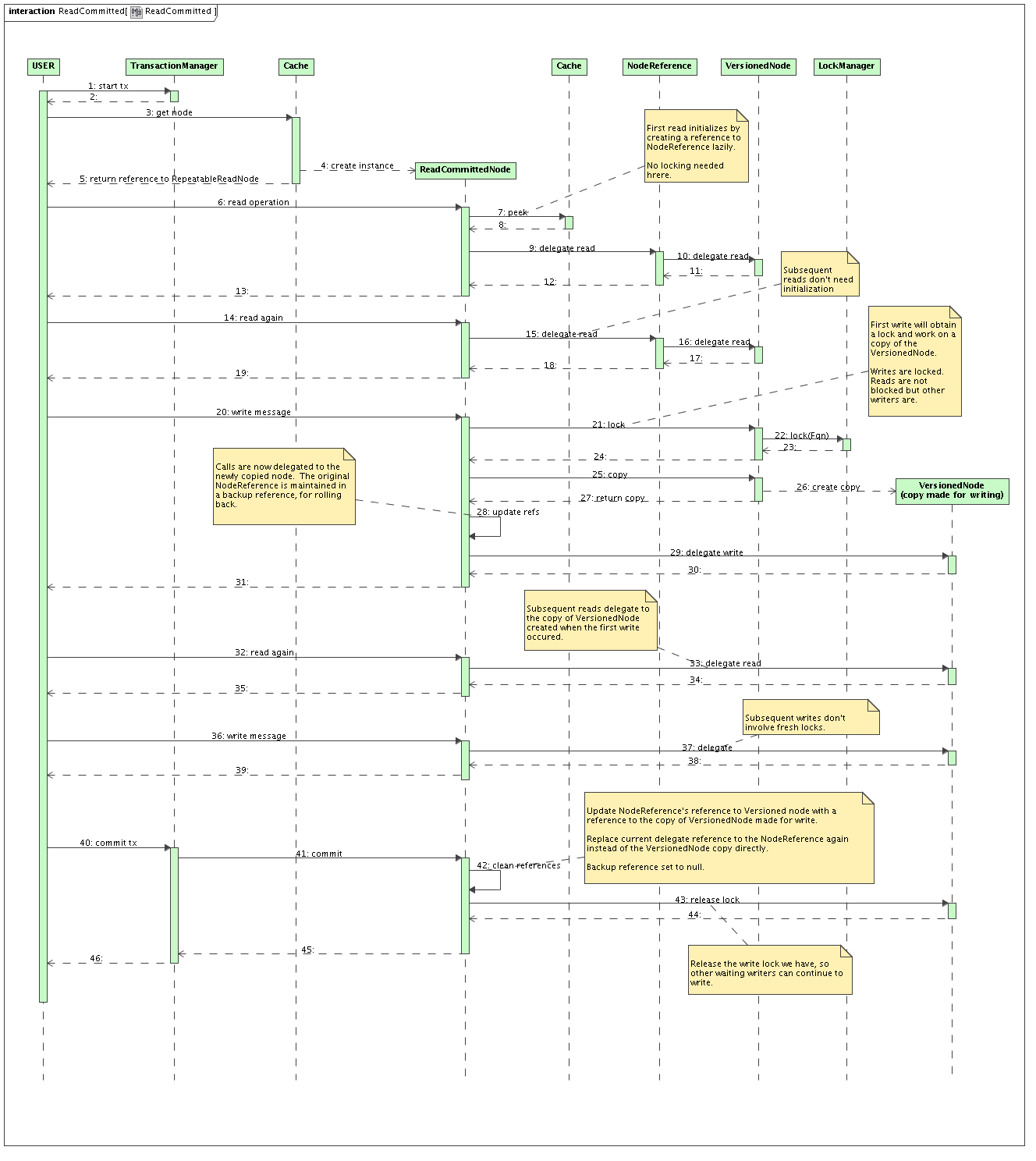
h3. READ_COMMITTED
http://community.jboss.org/servlet/JiveServlet/download/10272-50-4677/Rea...
Exactly the same as REPEATABLE_READ, except that:
* ReadCommittedNode has a reference to NodeReference rather than VersionedNode
* No version check is done when a write starts (write skew is not a problem with
READ_COMMITTED)
* When committing
** ReadCommittedNode reinstates the reference to the NodeReference
** Updates the NodeReference to point to the copy of VersionedNode
h4. Read committed achieved by:
* Readers and writers working delegating to a VersionedNode via the NodeReference
* NodeReference updated when a writer commits - and everyone sees this commit
h3. Locking
* Locks still needed for the duration on a write (exclusive write)
** No locks needed when reading
* All locks should be on the Fqn, not the VersionedNode itself since this is replaced
* Implemented using lock striping to reduce the number of locks in the system if there are
a large number of nodes.
** VersionedNode still exposes lock() and release() methods
** Delegates to LockManager.lock(Fqn) and release(Fqn)
** LockManager is an interface, configurable.
*** StripedLockManager uses something similar to
http://labs.jboss.com/file-access/default/members/jbosscache/freezone/doc...
(used by cache loader implementations at the moment)
h3. Implementation details
MVCC will be implemented using 3 interceptors: an MVCCLockingInterceptor, an
MVCCNodeInterceptor, and an MVCCTransactionInterceptor, which would be responsible for
acquiring the locks needed (in the case of a write), creating of a wrapper node for the
invocation, and the switching of references at the end of a transaction respectively.
h3. Documentation
TODO: Illustrate MVCC behaviour visually, during concurrent writes, creates, deletes,
create + delete.
h3. Tombstones
When a node is deleted, a tombstone will need to be maintained to ensure version numbers
are maintained for a while.
h3. Drawbacks
* Creation of a RepeatableReadNode or ReadCommittedNode with every call to
Cache.getRoot().getChild()
** Efficient if this is cached and reused all the time
* cache.put(Fqn, Key, Value) will probably call getRoot().getChild(Fqn).put(Key, Value)
** This may be less efficient since doing something like for (int i=0; i<100; i++)
cache.put(fqn, key+i, value+i) will result in 100 AbstractDelegatingNode instances
created.
** This can be minimised by optimisations such that a peek() for nodes happens only once
per call, and put it in the InvocationContext. All interceptors look first in IC for the
node - if null, peek() and set in IC. If transactional, IC mapped to TxCtx. (Necessary
for calls directly to Cache.get(), Cache.put() in MVCC to maintain refs to the same
RRNode/RCNode for the duration of a Tx)
* Always does a copy on write. Could be expensive.
** But caches are meant to be optimised for reading anyway.
h2. Timescales
The plan is for this to be in JBoss Cache 3.0.0. JBoss Cache 2.0.0 is close to release
now, and the next major release will be JBoss Cache 2.1.0, which will make use of JBoss
AOP and JBoss Microcontainer. The original plan was to create JBoss Cache 2.2.0 with
http://community.jboss.org/docs/DOC-10278, but MVCC (and
http://community.jboss.org/docs/DOC-10284) may be higher priority features that may
warrant 3.0.0 to be elevated in importance and http://community.jboss.org/docs/DOC-10278
to be pushed to 3.1.0.
--------------------------------------------------------------